Can I Apply Again If My Visa Gets Rejected? Everything You Need to Know
If you?ve been waiting for several weeks and finally got a visa rejection letter, it can be so discouraging especially if you?ve already gotten a tick...
30-04-2026
Read More
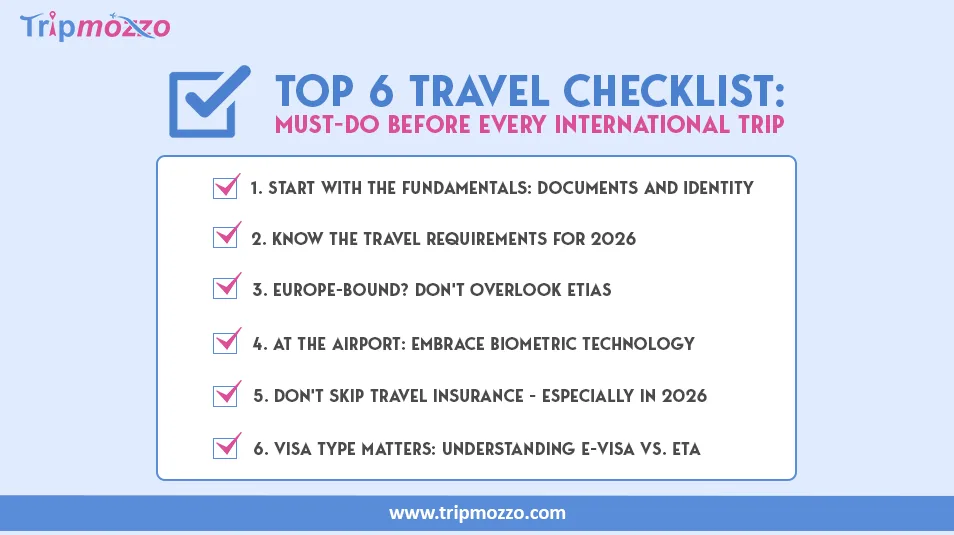
Table Of Content
In 2026, international travel will have never been as seamless, digital, and personalized, but also more complex in nuanced ways. Governments are increasing the border security, airlines are embracing new technologies and passengers are likely to be more enlightened and ready. You may be planning a vacation, business or even long term stay abroad, a solid and extensive plan can mean the difference between a hassle free journey or a tense one.
No matter how experienced a globetrotter or whether it is your first overseas experience, this guide will take you through all the important stops on your international travel checklist 2026 - the only way you will experience the unexpected on your trip is in a good way.
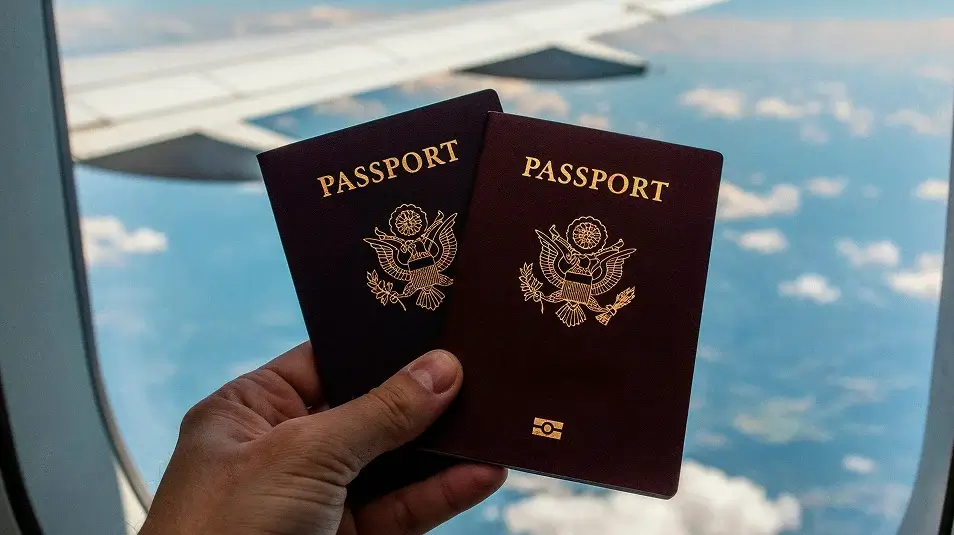
Check the expiry date of your passport before you can even open a browser tab to check the flights. Several countries have it as a requirement that it must be valid not less than six months before your date of returning. When yours is coming down to the wire, renew early - the passport offices of most countries have been taking up to eight weeks or longer.
In addition to the passport, pack in the following:
Having color-photocopies of all important papers kept in a different place preferably in a cloud folder than the original ones can be literally a life-saving measure in case your bag is lost.
The international travel regulation level changed significantly towards 2026. Governments all over the world have been increasing the entry procedures and at the same time attempting to streamline the digital experience. This knowledge of the exact travel requirements for 2026 in your destination country is not negotiable, and this is where most travelers fail, with the help of old blog posts or suggestions of their friends who visited a few years ago.
The important aspects to check about this or that destination:
The golden rule: Visit the official government immigration site of the country you are going to and your home countries foreign travel advisory site preferably both 30 days before you are going.
When Europe has been on your list of places to travel and you have been waiting to have the right time then 2026 is as good as any but you will need to plan ahead more than travelers did in the past years. The Europe ETIAS requirements 2026 will have to be considered by non-EU citizens of the states that used to have a visa-free entry into the country.
The European Travel Information and Authorisation System (ETIAS) is the European version of systems such as the US ESTA, or the Canadian eTA. It is not a visa, but an obligatory pre-travel approval of qualifying non-EU citizens, visiting the Schengen Area. The entire application is online and in most instances, the application is processed within minutes to several hours. But there are those that are sent back to be reviewed and may take up to 30 days - this is a very bad idea to leave it to the last minute.
The following is a brief outline of what ETIAS will entail by 2026:
ETIAS authorization is valid throughout the Schengen Zone, that is, you do not require an authorization in each country. However, it is associated with your particular passport and in case you renew your passport when you receive ETIAS, it will require you to re-apply.
Noteworthy, ETIAS approval is not a guarantee of entry. Border officers reserve the right to refuse entry to you depending on the circumstances of your visit. Bring supporting documents as hotel reservation, back flight, travel insurance etc. to ensure a hassle-free check-in.
After sorting out your documents and authorizations, you should consider the actual experience of passing through the airport. Biometric infrastructure is rapidly being developed in airports around the US, UK, EU, Singapore, UAE and Japan and 2026 is the year when many of these systems will cease to be an optional pilot project and become the new normal.
The following biometric airport boarding tips will enable you to navigate through the terminal without being confused:
Biometric boarding is not a gimmick, but is actually changing the air travel experience. Early adapting passengers have reported it to be drastically stress reduction at the airport.
This is the most commonly known yet unwelcoming travel fact that most individuals find themselves paying over 50,000 USD to get their medical evacuated out of some remote region in Southeast Asia. Cancellation of the trip because of an emergency in the family can leave thousands of non-refundable tickets wiped out. A laptop in a bag that is lost is a very costly souvenir.
Travel insurance has never been any less significant, but category has changed in meaning over the past few years. The smart traveler would pick international travel insurance with AI support as the best option in 2026 - the policies will have support on AI-driven claims processing, bots that assist in real-time, and even anticipate upcoming travel inconveniences.
So, what is AI-powered travel insurance provide?
In comparison of policies, seek: medical coverage of at least 250,000 USD (greater in the case of US travelers, whose medical bills are most expensive in the world), emergency evacuation coverage, trip cancellation and interruption, baggage and personal effects coverage and 24/7 emergency contact coverage
Among the most widespread misunderstandings that first-time international travelers and even more experienced traveling to new destinations may have is the distinction between an e-Visa and Electronic Travel Authorization. The difference between e-Visa vs. ETA will not only be scholarly knowledge but making the wrong choice or applying to the wrong visa may lead to a denied boarding pass or a very uncomfortable discussion at the immigration desk.
The major differences in a nutshell:
|
e-Visa |
ETA |
|
|
Entry right |
Guaranteed |
Authorization to obtain entry. |
|
Processing time |
24 hrs ? 2 weeks |
Minutes to hours |
|
Documentation needed |
More |
Minimal |
|
Cost |
Moderate to high |
Low to moderate |
|
Validity |
typically one or two entry. |
Frequently multi-entry, extended validity. |
|
Example countries |
Turkey, Saudi Arabia |
New Zealand, Canada, Australia. |
Both of these systems would be much better than standing in line at an embassy but a mix-up would lead to real issues. Always note the type of authorization that is needed by the immigration department of the country to which you are traveling to and apply through the official government portal.
Having outlined all the above, the following is a brief checklist that should be made in the week prior to departure:
The global travel in 2026 will be characterized by planning, consciousness and intelligent utilization of technology. Whether you study the changing regulations of entry or adopt biometric systems and the appropriate type of insurance and visa, all your activities even before leaving contribute to your overall experience. A good trip will not only reduce stress levels but will also enable you to get the full experience of the adventure to come with ease and confidence.
Ready to travel smarter and stress-free? Begin your checklist now and have your next global journey your most comfortable.
All Categories
Looking for detailed information on airline policies, terms & conditions, and more?
Call now to get complete guidance.
+1-888-933-0080Recent Articles