Can I Apply Again If My Visa Gets Rejected? Everything You Need to Know
If you?ve been waiting for several weeks and finally got a visa rejection letter, it can be so discouraging especially if you?ve already gotten a tick...
29-06-2026
Read More
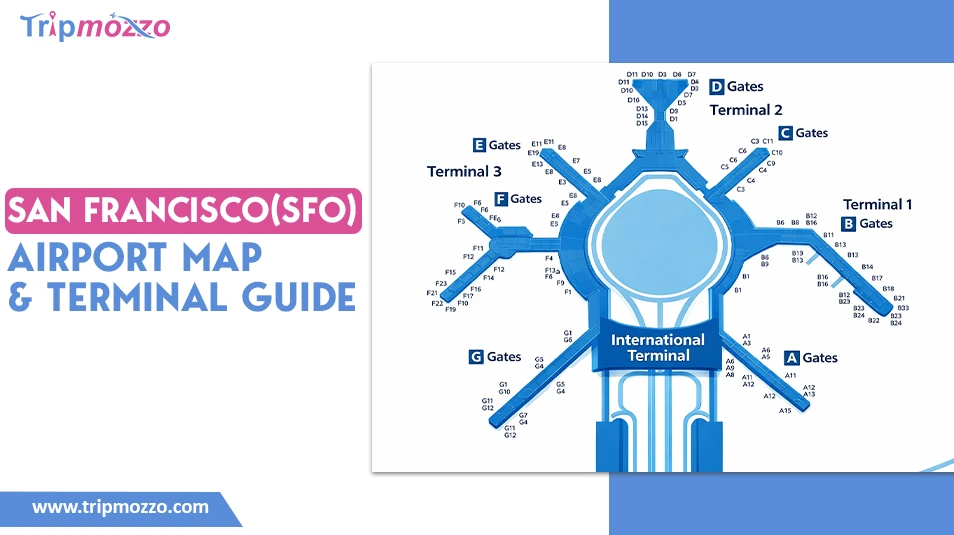
Table Of Content
|
Category |
Specification |
|
IATA |
SFO |
|
Airport Type |
Public / International |
|
Owner / Operator |
City & County of San Francisco / San Francisco Airport Commission |
|
Serves |
San Francisco Bay Area |
|
Location |
San Mateo County, California (13 miles south of San Francisco) |
|
Opened |
May 7,1927 |
|
Hub for |
United Airlines and Alaska Airlines |
|
Coordinates |
$37^\circ37'08'"N \quad 122^\circ22'31'"W$ |
|
Official Website |
|
|
Total Passengers |
Approx. 50 million (annual average) |
|
Aircraft Operations |
Approx. 400,000 annually |
|
Total Cargo |
Over 500,000 metric tonnes |
Travelers tend to look for SFO terminals by airline so as to be able to find the check-in counters and departure gates conveniently. There are four terminals at San Francisco International Airport, and they are named based on the alliance and needs of the airlines. The table below provides a ready reckoner for some of the important airlines along with their terminal.
|
Airline |
Terminal at SFO |
|
United Airlines |
Terminal 3 and International Terminal |
|
Southwest Airlines |
Terminal 1 |
|
Frontier Airlines |
Terminal 1 |
|
JetBlue Airways |
Terminal 1 |
|
Alaska Airlines |
Terminal 1 |
|
Delta Air Lines |
Terminal 2 |
|
American Airlines |
Terminal 1 |
|
Air Canada |
International Terminal |
|
British Airways |
International Terminal |
|
Lufthansa |
International Terminal |
|
Emirates |
International Terminal |
|
Qatar Airways |
International Terminal |
|
Singapore Airlines |
International Terminal |
|
Air France |
International Terminal |
|
KLM Royal Dutch Airlines |
International Terminal |
The gate-letter layout can also be helpful for navigating, especially if you are asking yourself the question: what terminal are D gates in SFO? SF International Airport's gates are grouped into terminals, making it easier to find check-in desks, louges, and connecting flights.
|
Gate Letter |
Terminal |
Example Gates |
|
B Gates |
Terminal 1 |
B2, B6, B18 |
|
C Gates |
Terminal 3 |
C1, C4, C12 |
|
D Gates |
Terminal 2 |
D1, D7, D15 |
|
E Gates |
International Terminal A |
E7, E12, E15 |
|
F Gates |
International Terminal A |
F1, F12, F22 |
|
G Gates |
International Terminal G |
G3, G8, G99 |
When it comes to SFO, you may get a little confused with SFO International Terminal A or G? The airport's International terminal is split into two boarding areas, A and G, with most of the international airlines and a few domestic airlines using A and United Airlines' international flights and Star Alliance partners using G. The two sections are linked by AirTrain and walkways at the airport, and are accessible via the International Terminal.
|
Boarding Area |
Major Airlines |
Location |
|
Terminal A |
British Airways, Air France, Emirates, Lufthansa, JetBlue |
South side of the International Terminal |
|
Terminal G |
United Airlines, Air Canada, ANA, Singapore Airlines |
North side of the International Terminal |
The san francisco airport layout accommodates four large terminals stacked in one circle. It possesses three domestic terminals-Harvey Milk Terminal 1, Terminal 2, and Terminal 3-and the Dianne Feinstein International Terminal. The airport is further divided into seven boarding zones (A-G). Terminal 3 is the main base of United Airlines, while the International Terminal is separated into Boarding Areas A and G. Every terminal is connected via the 24-hour automated AirTrain and airside walkways.
The SFO airport parking map allows for travelers to select from a variety of parking facilities based on the terminal, duration, and budget. Domestic and International Garages are available for short-term parking, Long-Term Parking for longer stays and Valet Parking for convenience. All parking areas are connected by the free AirTrain system.
|
Parking Option |
Best For |
Access to Terminals |
How to Reach |
|
Domestic Garage |
Terminal 1, 2, and 3 passengers |
Terminal 1, 2, 3 |
Walking bridges and AirTrain |
|
International Garage A |
International Terminal A |
International A |
Short walk |
|
International Garage G |
International Terminal G |
International G |
Short walk |
|
Long-Term Parking |
Budget-conscious travelers |
All terminals |
AirTrain Red or Blue Line |
|
Valet Parking |
Premium convenience |
All terminals |
Located near Domestic Garage |
Finding your way through San Francisco International Airport becomes easier once you notice how the sfo airport terminal map loops; four terminals wrap around a central hub for parking and transit. The map of SFO terminals makes more sense when you see that each section connects like spokes on a wheel.
Here is the complete guide about SFO Terminal 1 Map for the easy routing for the passengers:
SFO Terminal 1 Airlines Operating:
American Airlines, JetBlue and Southwest Airlines.
SFO Terminal 1 Parking:
Connected to the Domestic Garage (Levels 1-5) via pedestrian walkways.
SFO Terminal 1 Gates & Layout:
Features Boarding Area B (Gates B1?B27). It utilizes a single concourse design with spacious walkways, updated passenger amenities, and convenient connections to airport transportation services.
SFO Terminal 1 Amenities & Lounges:
Highlights include the Admirals Club (American Airlines). Amenities feature gender-neutral restrooms and animal relief areas.
SFO Terminal 1 Traveler Perks:
Home to the "Harvey Milk: Messenger of Hope" museum exhibit and the first LEED Platinum airport terminal certification globally.
SFO Terminal 1 Restaurants:
Local favorites such as Amy's Drive-Thru, Bourbon Pub and Ritual Coffee.
If you have no idea where to go after entering the Terminal 2 then here is the complete guide for you about the map and places to go to on Terminal 2:
SFO Terminal 2 Airlines Operating:
Alaska Airlines and Delta Air Lines.
SFO Terminal 2 Parking:
Directly accessible from the Domestic Garage; Valet parking is also available.
SFO Terminal 2 Gates & Layout:
Comprises Boarding Area C (Gates C1-C11) and Boarding Area D (Gates D1-D18).
SFO Terminal 2 Amenities & Lounges:
Features the Alaska Lounge and Delta Sky Club. Notable for its "Recompose" area post-security.
SFO Terminal 2 Traveler Perks:
Yoga room hydration stations and extensive SFO Museum art installations.
SFO Terminal 2 Restaurants:
Upscale options like The Plant Cafe Organic and Napa Farms Market.
The San Francisco Airport Map Terminal 3 is a major hub for the United Airlines which features the 36 gates across Concourse E and F. It serves domestic flights and features amenities like yoga rooms dinings and SFO exhibition.
SFO Terminal 3 Parking:
Linked to the Domestic Garage; it also forms the main way to the BART station.
SFO Terminal 3 Gates & Layout:
Boardings Area E (Gates E1-E13) and Boarding Area F (Gates F1-F22).
SFO T3 Terminal Amenities/Lounges:
Several United Clubs and the United Global Services Lounge the exclusive one.
SFO Terminal 3 Traveler Perks:
Family play areas a dedicated yoga room and a post-security connector to the International Terminal (G).
SFO Terminal 3 Restaurants:
Popular venues include Yankee Pier, San Francisco Giants Clubhouse and Fraiche.
There are two parts of International terminal from which one is Terminal (A) south:
SFO Terminal (A) Airlines Operating:
Major global carriers including British Airways, Emirates, Air France, Cathay Pacific and Virgin Atlantic.
SFO Terminal (A) Gates & Layout:
Boarding Area A. It is a linear concourse with high ceilings and natural light.
SFO Terminal (A) Amenities & Lounges:
Features a dense cluster of flag-carrier lounges including the Virgin Atlantic Clubhouse and Emirates Lounge.
SFO Terminal (A) Traveler Perks:
The SFO Museum Aviation Museum & Library is located pre-security offering a deep dive into flight history.
SFO Terminal (A) Facilities:
Medical clinic (Travelers' Medical Service) and currency exchange.
SFO Terminal (A) Transportation:
Immediate access to the AirTrain and the International G Garage.
SFO Terminal (G) Airlines Operating:
United Airlines (international) and Star Alliance affiliates such as Lufthansa, Singapore Airlines and EVA air.
SFO Terminal (G) Gates & Layout:
Boarding Area G. It is located strategically close to the Terminal 3 so that there can be easy domestic-to-international transfers.
SFO Terminal (G) Amenities & Lounges:
The residence of the award winning United Polaris Lounge which is specifically meant to accommodate long class business travelers.
SFO Terminal (G) Traveler Perks:
Offers some of the best aircraft spotting locations in the airport with floor-to-ceiling glass overlooking the runways.
SFO Terminal (G) Facilities:
High-end luxury boutiques and automated passport control kiosks.
SFO Terminal (G) Transportation:
Directly houses the BART station entrance providing a 30-minute rail link to downtown San Francisco.
A traveler who will require SFO Airtrain map needs to know that Airtrain is a free train system which runs all day long, 24 hours per day, and automatically. Airtrain connects all terminals, parking facilities, BART Station, and the Rental Car Center, giving easy access to San Francisco International Airport in a safe environment.
The Red Line runs in both directions and stops at:
Garage A / AirTrain Station
International Terminal G
International Terminal A
The Blue Line follows the same route as the Red Line and continues to:
|
Destination |
AirTrain Line |
Approximate Time |
|
BART Station |
Red or Blue |
5?10 minutes |
|
Rental Car Center |
Blue Line |
10?15 minutes |
|
Grand Hyatt at SFO |
Red or Blue |
5 minutes |
|
Long-Term Parking |
Red or Blue |
8 minutes |
|
Any Terminal |
Red or Blue |
2?8 minutes |
Inter-terminal movement at the San Francisco International Airport (SFO) is intended to be both fast and convenient that provides the travelers with an option between a rail transport system and effective walkways.
The AirTrain is SFO's free fully automated people mover that operates 24 hours a day. It is the primary method for moving between terminals when you are outside the secure area.
In case you have already passed through the security and have a valid boarding pass then you can even move between all terminals without leaving the secure area. This would be suitable in domestic-to-domestic or domestic-to-international links.
For those who prefer to walk while outside the secure area all terminals are connected by a continuous circular sidewalk. The International Terminal is positioned between Terminal 1 and Terminal 3 making it a very short walk from either domestic hub.
There is an airport baggage claim level available at the San Francisco International Airport Terminal, which can be accessed from the Arrivals Level where one can get their luggage. The SFO baggage claim map will make the job convenient for one to locate his baggage carousels, as well as ground transportation and AirTrain links.
|
Terminal |
Baggage Claim Level |
Airlines |
Ground Transportation Access |
|
Terminal 1 |
Arrivals Level (Level 1) |
Southwest, JetBlue, Frontier, Alaska |
Taxi, rideshare, AirTrain |
|
Terminal 2 |
Arrivals Level (Level 1) |
Delta and partners |
Taxi, rental cars, AirTrain |
|
Terminal 3 |
Arrivals Level (Level 1) |
United Airlines |
BART, taxi, AirTrain |
|
International Terminal A |
Arrivals Level (Level 1) |
Air France, British Airways, Lufthansa |
Taxi, AirTrain, BART |
|
International Terminal G |
Arrivals Level (Level 1) |
United International, Singapore Airlines, Air Canada |
BART, AirTrain, rideshare |
Frequently Asked Questions
How do I navigate SFO Airport?
Navigating SFO is highly intuitive due to its centralized circular design. For travel outside of security the automated AirTrain provides constant 24-hour service between all terminals garages and transit hubs. Once you are past security you can follow the clearly marked "All Gates" signage to utilize the post-security walkways that now link every terminal across the airport.
Can I go from Terminal 2 to 3 at SFO?
One can fully travel between Terminal 2 and Terminal 3. The secure airside connector can be used by the travelers to make a smooth transition between these boarding areas without having to exit and re-clear TSA security. This is a short less than ten minutes walk that offers one the variety of the dining and lounge facilities in the two spheres.
Which terminal is international at SFO?
Dianne Feinstein International Terminal is the main point of entry to all the foreign travel. It is strategically divided in two wings that is Boarding Area A to the south and Boarding Area G to the north. This terminal can accommodate most of the foreign flag carriers whereas there are certain domestic terminals receiving international arrivals of pre-clearance airports like Canada.
What is the difference between Terminal 1, 2 and Terminal 3?
The main distinction is in the airline tenants and atmospheric design. Terminal 1 (Harvey Milk) is an LEED Platinum structure with services to American and Southwest. Terminal 2 is devoted to wellness and sustainability between Alaska and Delta passengers. Terminal 3 is the domestic United Airlines large-size terminal with direct links to the BART rail station and International G gates.
How to find flight terminal information?
Passengers can verify their terminal assignment by consulting their digital boarding pass or the official mobile application of their respective airline. Upon arrival at the airport real-time Flight Information Display Systems (FIDS) are located throughout the departure halls. Additionally the official SFO website provides a live flight tracker and a comprehensive directory of airline-to-terminal assignments.
All Categories
Looking for detailed information on airline policies, terms & conditions, and more?
Call now to get complete guidance.
+1-888-933-0080Recent Articles