
Can I Apply Again If My Visa Gets Rejected? Everything You Need to Know
If you?ve been waiting for several weeks and finally got a visa rejection letter, it can be so discouraging especially if you?ve already gotten a tick...
12-05-2026
Read More
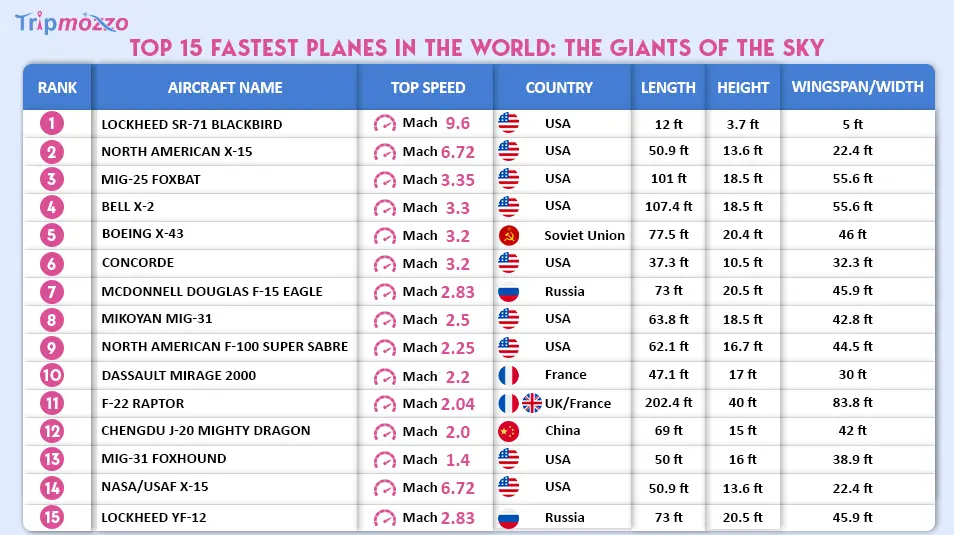
Table Of Content
Aviation engineers, pilots, and aviation enthusiasts have been dreaming of faster than sound flying for decades. The speed of the fastest plane in the world has taken technology to incredible limits, whether in military reconnaissance or experimental hypersonic planes. Apart from being symbols of engineering excellence, these incredible machines are also proof of the advancement of aircraft.
While some have been developed for their role as warplanes, others have been developed for their ability to break the speed and atmospheric travel records. Many of these legendary aircraft still set records for their maximum speed; some can fly several times faster than the speed of sound. As far as the world's fastest airplane, experimental and military aircraft hold the record over comfort and efficiency of commercial jets.
You will encounter the fastest airplanes in aviation history which include historic aircraft such as the SR-71 Blackbird, X-15, Concorde, and MiG series fighters. You will also learn how hypersonic technology evolved and which aircraft remains the fastest airliner ever built.
The aircraft demonstrates the entire timeline of aviation development which includes both engineering progress and speed records, because of research work that created hypersonic vehicles, military jets and supersonic passenger aircraft used worldwide.
The SR-71 Blackbird is often considered the ultimate symbol of speed and stealth in aviation history. Developed during the Cold War, this reconnaissance aircraft could cruise at speeds above Mach 3 while flying at extremely high altitudes. Its titanium body helped it withstand the intense heat generated by high-speed flight.
For decades, the SR-71 remained nearly impossible to intercept. Enemy missiles struggled to catch it because the aircraft could simply outrun threats. Even today, many aviation experts still refer to it as one of the greatest examples of advanced aerospace engineering.
The SR-71 is frequently cited as the fastest plane ever to enter operational military service.
The X-15 rocket plane remains today as one of the most exceptional experimental aircraft which people have ever created. The aircraft served as a combined operational platform which both the United States Air Force and NASA could use to reach speeds that exceeded Mach 6, making it one of the fastest manned aircraft to have existed throughout history.
The X-15 program provided scientists with a knowledge of high speed aerodynamics, atmospheric reentry and spaceflight technology. The pilots who operated the aircraft successfully reached the boundary of space received special recognition through the award of "Astronaut Wings."
Its remarkable achievements transformed the design process for upcoming spacecraft and the study of hypersonic flight.
When it was first deployed, the Soviet-built MiG-25 Foxbat caught western intelligence agencies off-guard. It was intended to be an interceptor/reconnaissance plane that could travel at Mach 3.2 in some circumstances.
The plane was equipped with powerful engines, and was built of stainless steel to withstand extreme heat at high speeds. In spite of its limited agility in comparison to present day fighters, because of its raw speed it was a formidable aircraft during the Cold War period.
The MiG-25 stands as one of the fastest military aircraft that has ever been developed.
The Bell X-2 was an experimental supersonic and hypersonic flying wing designed and built by the Bell Corporation. It was now known as a "famous" aircraft after breaking Mach 3 in test flights in the 1950s.
The programme experienced a number of tragic accidents but the research obtained from the X-2 contributed to the knowledge of high speed aerodynamics and aircraft stability.
The plane was a significant milestone in the development of hypersonic flight.
The X-43 is the fastest air-breathing aircraft, with the record speed set by the aircraft itself. The unmanned experimental aircraft flew at an amazing Mach 9.6 with a scramjet engine.
This achievement showed the immense potential of scramjet propulsion systems in the future hypersonic transportation and in the military field.
To this day, the X-43 is one of the most revolutionary aircraft built on aerospace history.
Concorde revolutionised commercial aviation by introducing supersonic passenger flight. It flew faster than two times the speed of sound and it was a real time saver in continental travel.
Time to travel between London and NY is less than four hours, the fastest ever made airliner. It was recognized immediately throughout the world for its elegant delta wing configuration and its low nose.
The planes were eventually retired from service and the Concorde is one of the most famous aircraft in history due to its high operational costs and environmental problems.
The F-15 Eagle is undoubtedly one of the most successful fighter planes ever produced. The aircraft is renowned for its outstanding speed, power and combat ability and has had an outstanding combat record for decades.
The F-15 can attain Mach 2.5 and features advanced avionics, speed and agility. A number of improved variants of the aircraft are still in use with the military.
The MiG-31 Foxhound has been designed as a high-speed interceptor for the protection of enormous Russian space. Can attain speeds of up to Mach 3 and armed with high-tech long-range interception radar.
The maximum speed of the airplane continues to play an important role in Russian air defense operations.
The F-100 Super Sabre was the first U.S. Air Force fighter to be supersonic in level flight. It was a significant step in jet fighter technology in the 1950s.
The aircraft was extensively used during the Vietnam War and influenced the design of the next generation fighter.
The Mirage 2000 is a French multirole delta wing fighter aircraft, famous for its speed and high capability.
The plane has been flown by many air forces around the world and is still highly regarded for its dependability and flexibility.
The F-22 Raptor is a fighter that incorporates stealth and exceptional speed and agility. It is believed to be one of the most sophisticated fighter planes ever produced.
It has a supercruise capability, meaning that it can fly faster than the speed of sound without consuming fuel in afterburners, making it more fuel efficient and combat effective.
The J-20 Mighty Dragon is China's progress in the stealth fighter field. It is a modern aircraft with an array of avionics, stealth shaping and high speed.
The J-20 will compete with the world's top 5th generation fighter planes.
MiG-31 Foxhound is one of the fastest interceptor aircraft now in service. It is fast and has radar systems that can be used to track multiple targets in the air at the same time.
The plane still plays a vital role in the Russian Air Force.
A special mention needs to be made for hypersonic flight research contributions by NASA/USAF X-15. The record-breaking flights were instrumental in helping engineers learn important technology that they would use in space programs.
The aircraft was a pioneer in the field of human powered flight through the atmosphere.
YF-12 is an American experimental interceptor aircraft based on the SR-71. It reached super-sonic speeds over Mach 3, and demonstrated high technology radar and missile capabilities.
The aircraft had a significant impact on the development of military aviation and although only a few prototypes were constructed, the impact was significant.
The first high-speed aircraft took to the skies just after WWII, when nations began testing jet fliers. The United States and the Soviet Union race to build faster and faster planes, during the Cold War period. This competition inspired the development of supersonic and hypersonic flight technology.
Supersonic aircraft are those that fly at speeds exceeding those of the speed of sound or Mach 1. Hypersonic aircraft reach speeds that exceed Mach 5. The development of these aircraft required the creation of new materials which needed to be combined with more powerful engines and heat-resistant structures and advanced aerodynamic designs.
The X-15 rocket plane development represents a major achievement which advanced the field of aviation. The SR-71 Blackbird became an extremely famous reconnaissance aircraft because it combined high-speed capabilities with advanced stealth technology.
Commercial aviation also got into the race with Concorde, the iconic supersonic passenger jet which is still the world's fastest airliner. Concorde was retired in 2003, but it had demonstrated that civil aviation was capable of achieving a dramatic reduction in the time needed for long-distance air travel.
Hypersonics are still being investigated for military and civilian aircraft applications. Countries all over the world are investing in next generation aircraft that can fly at an unprecedented speed. The future of global transportation may be redefined with these developments.
The most rapid aircraft was developed to serve military needs and scientific studies and to achieve supersonic flight capabilities. They established new speed records while advancing aviation technology beyond its existing limits, which still captivates aerospace engineers in the present day.
|
Rank |
Aircraft Name |
Top Speed |
Country |
Length |
Height |
Wingspan/Width |
Manufacturer |
|
1 |
Boeing X-43 |
Mach 9.6 |
USA |
12 ft |
3.7 ft |
5 ft |
Boeing/NASA |
|
2 |
North American X-15 |
Mach 6.72 |
USA |
50.9 ft |
13.6 ft |
22.4 ft |
North American Aviation |
|
3 |
Lockheed YF-12 |
Mach 3.35 |
USA |
101 ft |
18.5 ft |
55.6 ft |
Lockheed |
|
4 |
Lockheed SR-71 Blackbird |
Mach 3.3 |
USA |
107.4 ft |
18.5 ft |
55.6 ft |
Lockheed |
|
5 |
MiG-25 Foxbat |
Mach 3.2 |
Soviet Union |
77.5 ft |
20.4 ft |
46 ft |
Mikoyan-Gurevich |
|
6 |
Bell X-2 |
Mach 3.2 |
USA |
37.3 ft |
10.5 ft |
32.3 ft |
Bell Aircraft |
|
7 |
Mikoyan MiG-31 Foxhound |
Mach 2.83 |
Russia |
73 ft |
20.5 ft |
45.9 ft |
Mikoyan |
|
8 |
McDonnell Douglas F-15 Eagle |
Mach 2.5 |
USA |
63.8 ft |
18.5 ft |
42.8 ft |
McDonnell Douglas |
|
9 |
F-22 Raptor |
Mach 2.25 |
USA |
62.1 ft |
16.7 ft |
44.5 ft |
Lockheed Martin |
|
10 |
Dassault Mirage 2000 |
Mach 2.2 |
France |
47.1 ft |
17 ft |
30 ft |
Dassault Aviation |
|
11 |
Concorde |
Mach 2.04 |
UK/France |
202.4 ft |
40 ft |
83.8 ft |
Aérospatiale/BAC |
|
12 |
Chengdu J-20 Mighty Dragon |
Mach 2.0 |
China |
69 ft |
15 ft |
42 ft |
Chengdu Aerospace |
|
13 |
North American F-100 Super Sabre |
Mach 1.4 |
USA |
50 ft |
16 ft |
38.9 ft |
North American Aviation |
|
14 |
NASA/USAF X-15 |
Mach 6.72 |
USA |
50.9 ft |
13.6 ft |
22.4 ft |
North American Aviation |
|
15 |
Mikoyan MiG-31 |
Mach 2.83 |
Russia |
73 ft |
20.5 ft |
45.9 ft |
Mikoyan |
The fastest aircraft in the world has produced some of the most famous planes and aviation legends through its development. The SR-71 Blackbird, X-43 and Concorde all demonstrate how human beings strive to set new speed records.
The aircraft on this list created distinct contributions to aerospace engineering through their military developments and testing work and their service in commercial aviation. The aircraft from this period include planes that remain operational today while others exist as museum exhibits yet both groups have shaped engineering and pilot training for future generations.
The development of aviation technology brings closer to achieving goals of constructing faster and more sophisticated aircraft. The world may witness the emergence of new hypersonic airplanes which will revolutionize global human travel in the future.
All Categories
Looking for detailed information on airline policies, terms & conditions, and more?
Call now to get complete guidance.
+1-888-933-0080Recent Articles