Can I Apply Again If My Visa Gets Rejected? Everything You Need to Know
If you?ve been waiting for several weeks and finally got a visa rejection letter, it can be so discouraging especially if you?ve already gotten a tick...
17-04-2026
Read More
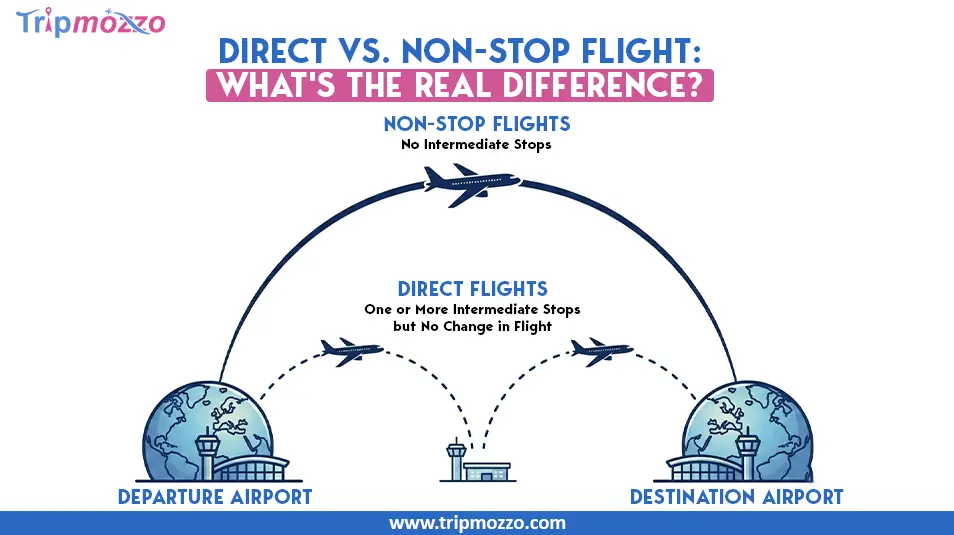
Table Of Content
Travelers usually think that direct and non-stop are synonymous when it comes to flight bookings. Nevertheless, these words define two kinds of trips and not knowing them may result in more time spent on a journey or unrealized destinations. The difference is particularly vital to know in case of a priority on speed, comfort or budget.
Simply put, a non-stop flight will bring you (without any interruptions) to your destination city, whereas a direct flight will have one or more stops on the way, but under the same flight number. This minor variance can greatly influence your overall travel experience such as the duration of your airtime, the duration of time that you have to get out of the airplane and even the way your luggage is handled.
This guide covers everything you need to know about direct vs non stop flight and make informed decisions and prevent being surprised during your trip.
A direct flight is a flight that has the same flight number between the origin and the destination but may include some or more stopovers that are in between. These stops may be made due to different reasons like refueling, picking up other passengers or due to fact of operation.
Although the airline sells it as a flight in itself, the passengers might have to face stopovers that prolong the travelling time. Some may keep you on the plane at the stop and others may require you to pull out and back in.
The main things to consider when it comes to direct flights:
This definition can easily be misleading to a traveler and it is always important to go through your itinerary before you make a booking.
Knowing the essence of the two types of flights will dispel the confusion and will make sure you get the right one depending on your travelling priorities.
A direct flight means a multi-leg flight that is bundled together with a flight number. Airlines find this structure economical in terms of operations particularly on long routes or routes with less demand.
Though sold as a one-way flight, the flight can have stops where the plane makes temporary landings. Such stops may be brief or prolonged based on such aspects as refueling, crew rotation, or boarding passengers.
This is the general way direct flights operate:
Direct flights are convenient when you do not want to change flight numbers and/or use connecting flights, however, they are not necessarily the fastest.
The simplest and most effective mode of transporting two cities is by a non-stop flight. It does not comprise any stops, aircraft transfers and no interrupt between landing and takeoff.
Non-stop flights are normally preferred by travelers who are more interested in speed and convenience.
Noteworthy features of non-stop flights are:
Though the non-stop flights are more convenient, they are at times pricier because of a high demand and less supply.
The contrast between direct flights and non-stop flights is not just a matter of definitions, but it is what impacts your time of travel directly, your comfort, and the whole experience.
One of the most important factors that can be compared in terms of these two options is travel time. Although the two flights might have a surface difference, the direct flights have an additional time due to the existence of stops.
The following are the reasons why there is a difference in the travel time:
You will almost always be better off with non-stop flights in case getting to your destination at the earliest possible time is what matters.
Direct flights may have a great difference in boarding and deplaning experience based on the airline and route.
Direct flights can entail more processes affecting the comfort of passengers unlike non-stop flights whose process is straight forward.
The process includes key aspects such as:
These extra processes can transform direct flights into a hybrid of non-stop and connecting flights.
If you are required to deplane during a direct flight stop, the process is similar to a transit. Make sure you have your digital boarding pass ready, much like our guide for Emirates digital check-in suggests for smooth transitions.
Direct flights have both pros and cons, which are relative to your travelling objectives. Although they are convenient in certain situations, they might not necessarily be the best option.
Direct flights can potentially save money, which can be considered one of its largest benefits. To reach cost-effective consumers, airlines often offer such flights at lower prices than non-stop.
The trade-off however comes at the cost of increased travel time and potential inconvenience.
Advantages of direct flights:
Direct flights with multiple stops have a higher chance of minor delays. In cases of significant disruptions, policies like the Qatar Airways flight disruptions guide can help you understand your refund rights.
Disadvantages of direct flights:
These are some of the factors which travelers need to consider before making a choice.
Direct flights are usually characterized with technical stops especially on long route flights. These are not necessarily passenger stops but rather have to be there due to working reasons.
These stops can also help you prepare better to your journey, knowing them.
Important details about technical stops:
Knowing these stops will make sure that you are not taken unawares on your trip.
The most important thing is to ensure that you are either flying in a straight or a non-stop flight so as to be spared of such surprises or inconveniences.
Flight number represents one of the simplest methods to differentiate between direct and connecting flights, although this aspect does not always imply a non-stop trip.
The following is what to expect:
A close examination of these specifics may help to avoid misconceptions. Using advanced search filters is the best way to spot these differences. Our list of the best flight comparison tools for 2026 highlights platforms that clearly mark technical stops.
Technical stops are not necessarily evident as one goes through flight options, but they are generally listed in fine print.
In order to detect them:
Always be alert when going through your itinerary, so as to know what to expect.
The decision between direct and non-stop flights may be perplexing, with different airlines terminology and concealed information. This is where TripMozzo makes it easy.
TripMozzo has clear and concise information on every flight so that the traveler is able to make his or her decision without the confusion.
Key benefits include:
This openness assists the travellers to save them the hassles of getting caught off guard and make arrangements for their trips.
With TripMozzo, travelers can also compare various flight alternatives against each other, and it becomes easier to come up with the perfect combination of cost and convenience.
Comparison enhancing features:
With these tools, travelers would also be able to select the most appropriate flight option without having to sacrifice on their priorities.
It is important to learn how to distinguish direct flights and non-stop flights in order to make more intelligent travel choices. Direct flights may be cheaper and have easier booking systems, although non-stop flights are quicker and more convenient.
It is always important to read the terms of your flight before making your final booking, such as the number of stops, the time spent on the flight and how to board. Even some extra care can make a big difference in making the traveling experience a hassle-free affair.
No matter how much time you value, how much comfort you value, how much money you value, being aware of these differences gives you the power to select the most appropriate to your trip.
Frequently Asked Questions
Is a direct flight the same as a non-stop flight?
No, a direct flight can have stops whereas a non-stop flight flies directly to the destination without any landings in between.
Do I need to change planes on a direct flight?
No, not usually, but aircraft changes can sometimes occur, so never forget to have a check at your itinerary before booking to avoid unpleasant surprises at the time of traveling.
Are non-stop flights always more expensive than direct flights?
The cost of non-stop may be higher than that of the convenience flights as well because of the shorter route in time and convenience, however the price may be different based on the demand, route, and the time of booking.
Can I leave the airport during a direct flight stop?
It requires reliance on visa regulations and length of stop; the short technical stops do not typically permit leaving the airport or returning in the future.
How can I confirm if my flight has a stop?
Itinerary details such as total duration, stop indicators, and airport codes can be checked to determine whether or not your flight has any stops.
All Categories
Looking for detailed information on airline policies, terms & conditions, and more?
Call now to get complete guidance.
+1-888-933-0080Recent Articles