Can I Apply Again If My Visa Gets Rejected? Everything You Need to Know
If you?ve been waiting for several weeks and finally got a visa rejection letter, it can be so discouraging especially if you?ve already gotten a tick...
26-05-2026
Read More
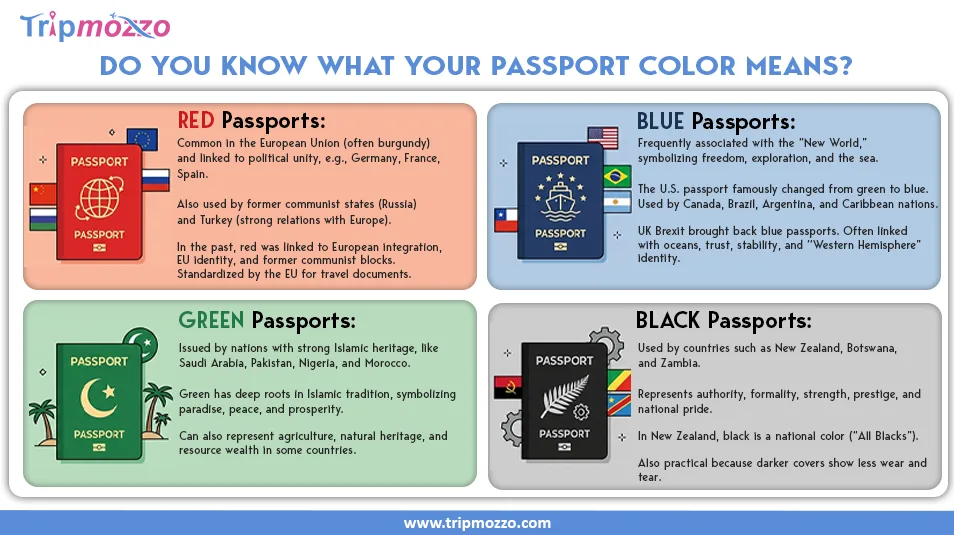
Table Of Content
Take out your passport now. What color is it? Navy blue? Burgundy red? Forest green? Most of us have been carrying our passports around for years and never asked ourselves why they are in this color?
Well, that was not a random choice of color. Governments around the world make conscious choices in designing passports, and the color on the cover may convey more than just a political message; it may also mirror a religious difference, a historical link or regional bonding. Your passport is kind of like a tiny flag, a diplomatic handshake squished into a small booklet; you just stuff it into your carry-on and go.
Passport colors kinda give this fascinating peek into the politics and culture of the world, whether you're a frequent flyer, a first-time traveler, or you're just sitting around, curious about how things really work out there. Let's unpack it.
Passport colors are not random. They are often chosen based on national identity, regional alliances, religion, geography, or historical background.
Across the world, the four most common passport colors are:
Each shade kind a carries a symbolic meaning, not just visually. Some countries pick colors to mirror unity with political blocs, while others lean into religious meaning or cultural symbolism , as if it's quietly understood.
However it's kinda important to understand this, the passport means way more than just its cover color. Like yeah, sure it looks simple, but the real power of a passport sits in international agreements not in how it appears, at all.
While your cover color displays your national heritage, ensuring your document is valid and packed with the right essentials is what guarantees entry. Pair your passport preparation with our comprehensive international travel checklist guide to avoid last-minute terminal hurdles
World Passports come in different colors, but honestly they can be sorted into a few main types. So let's see what each one actually is , and also why some countries decide to pick them.
Red Passports are a common feature in the European Union, with some countries having burgundy passports such as Germany, France, Spain and Sweden. This colour is associated with political and regional unity.
In the past, red has been linked to:
Turkey, on the other hand, has a red coloured passport, similar to European countries in appearance, and they have strong relations with both Europe and Asia. Burgundy was interesting because it was adopted by EU countries as a result of the efforts to standardise travel documents throughout the EU.
Blue passports are frequently associated with the "New World" and are symbols of freedom, exploration, and openness to the world.
One of the most well-known blue passports in the world is the U.S. passport. The U.S. adopted green to blue in the 1970s, as a gesture of unity with the Americas and democratic values.
Other countries using blue passports include:
Brexit for the United Kingdom brought back the design of the old British Passports which were burgundy rather than EU blue. This was as a result of a political and emotional change, symbolizing sovereignty and independence.
Blue is often associated with:
Green passports are issued by countries, like Saudi Arabia, Pakistan, Nigeria and Morocco. The colour is embedded in Islamic tradition as it represents paradise, peace and prosperity.
Green can also symbolize:
The green passport, for instance, is a symbol of Islam and a national identity in Pakistan. Green is also used in Nigeria to symbolise their rich natural resources and agricultural power.
Black passports are used in countries like New Zealand, and in some of the African countries like Botswana and Zambia.
Black is the color of:
In New Zealand, the black passport represents the national colour of the country, similar to the sports teams, such as the All Blacks. At times, some governments opt for black as it's practical as it is less likely to show wear and tear than lighter shades.
A lot of people believe that a passport is a document issued for international travel, but in fact, a government produces a variety of different passports depending on the traveler's function, objective of travel and official standing. This is why the two citizens from the same country can have entirely different colored passports and privileges.
Travelers need to understand the distinction between an official or ordinary passport, in order to be able to recognise how the world works beyond tourism and vacation travel.
|
Passport Type |
Who Receives It |
Main Purpose |
Common Privileges |
Example Passport Colors |
|
Ordinary Passport |
Regular citizens |
Tourism, study, work, business, family travel |
Standard international travel rights based on visa agreements |
India - Deep Blue, USA - Blue, Pakistan - Green |
|
Official Passport |
Government employees and public officials |
Official government duties abroad |
Faster visa processing and recognition for official travel |
India - Maroon, some countries use Gray or Blue |
|
Diplomatic Passport |
Diplomats, ambassadors, senior government officials |
International diplomatic assignments and state representation |
Diplomatic channels, special immigration treatment, limited diplomatic privileges |
UK - Red, USA - Black, India - Maroon |
|
Service Passport |
Government staff traveling for state-related work |
Administrative or technical government assignments overseas |
Limited official travel benefits depending on international agreements |
Often Gray, Green, or blue, depending on the country |
|
Emergency / Temporary Passport |
Citizens needing urgent travel documents |
Emergency travel situations such as lost or stolen passports |
Temporary international travel authorization |
Usually simplified versions with temporary validity |
|
Collective Passport |
Organized groups such as school tours |
Group international travel |
Shared travel authorization for approved groups |
Rarely used today; design varies by country |
Regardless of what colour your passport cover is, it's what's inside what really counts at the border and the biometric information that modern passports contain.
A passport contains a description of the bearer's appearance. This typically covers:
Biometric chips speed up crossing times at immigration e-gates. However, the physical inspection at airport security remains strict; make sure your cabin baggage completely aligns with the latest TSA liquid rules for 2026 guide before heading to the departure gate.
An eye color passport is a part of its traditional physical description for border agents to use in establishing identity along with the photo. Though there is a focus on biometrics, some other physical data is still included in the data page as a backup.
Today's passports are much more. Many modern passports bear a small gold symbol on the cover, the shape is a rectangle, it is an e-passport (electronic passport) with a built-in RFID chip. This chip stores:
In many countries, fingerprint (Fingerabdruck) is referred to as this.
A digital signature that ensures that the signature is not forged.
Countries such as the United States, the United Kingdom, Germany, Japan and India have made the full switch to biometric e-passports. These enhance security and accelerate the crossing process using an automated e-gate. According to ICAO, more than 1.2 billion e-passports are in circulation around the world.
Importantly, the colour of the passport cover does not impact the identity verification, it is exterior branding. The actual security is within the chip and the data page within.
Another misconception that needs to be dispelled is that a passport's colour is a direct reflection of the number of countries to which you can travel without a visa.
The "power" of your visa-free access to other countries depends on the relations between your own nation and others. There is no hierarchy among the passports that makes one more powerful than the other, and there is no hierarchy between the red passport and the green passport.
Actually it is the geopolitical influence of the country that dictates the strength of the passport. The Henley Passport Index shows the number of countries a passport allows a holder to enter without obtaining a prior visa, with the most powerful passports in 2024 being:
With 193+ destinations, Japan and Singapore have access to a wide range of international destinations.
Germany, France, Italy, Spain and possibly Portugal and Switzerland, are regularly in the top five.
The U.S. and the U.K. are strong, but have taken a little step backward in recent rankings.
In contrast, those traveling from Afghanistan, Iraq or Syria, for example, will find passport restrictions are not due to passport color, but rather due to geopolitical issues and diplomatic relations.
The takeaway? A well-heeled country with potent global connections bestows a powerful passport whether blue or red, green or black.
If your passport color represents an EU or transatlantic nation, you often have unparalleled transit access. For passengers planning multi-leg international journeys with long waiting times, optimizing your route via the best airports for long layovers can add mini-vacations to your trip at no extra cost.
The colour of your passport represents your country's soul, its history, religion, politics, and pride. A passport is red, blue, green, or black; it's the story book of, basically any country. Next time you travel, keep in mind that you're not only carrying just a document, but you're also carrying an identity, like a sort of "self" proof.
All Categories
Looking for detailed information on airline policies, terms & conditions, and more?
Call now to get complete guidance.
+1-888-933-0080Recent Articles