
Can I Apply Again If My Visa Gets Rejected? Everything You Need to Know
If you?ve been waiting for several weeks and finally got a visa rejection letter, it can be so discouraging especially if you?ve already gotten a tick...
19-05-2026
Read More
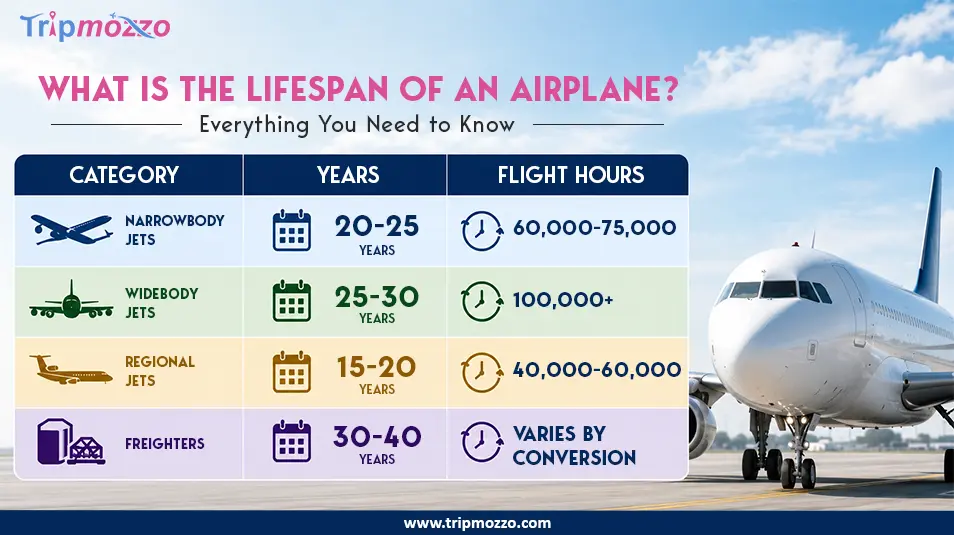
Table Of Content
The safe use of airplanes for decades and millions of passengers around the world is designed into them. When people begin to see older planes that continue to fly regularly, they tend to wonder how long the plane lasts. They build modern planes to be used heavily, to deal with climates, and to take off and land many times and thousands of flight hours. The life of a plane is not only in its years, though. Flight cycles, maintenance history, engine condition and structural strength are other factors that are taken into account by airlines. Many commercial aircraft can be maintained and upgraded to last for 20 to 30 years or more. This guide will answer questions about airplane lifespan which factors influence airplane durability and the reasons some airplanes operate for 50 years while others need retirement after shorter periods.
For someone wanting a simple answer to the question of how long do planes last, most modern commercial airliners last about 20-30 years. Some are scrapped due to high operating costs and others remain in service for over 40 years on cargo aircraft or smaller airlines.
Some of the key factors in the average lifespan of an airplane are:
The typical commercial jet flies several thousand times in its lifetime. Short haul domestic flights are subjected to higher stress as they make several takeoffs and landings on a daily basis. Investors of long-haul aircraft tend to enjoy longer operation thanks to a lower number of flight cycles despite the increased flight hours.
For example:
The lifetime of a plane is heavily influenced by maintenance programs. Airlines conduct rigorous inspections according to aviation authorities' prescribed schedules in order to keep aircraft safe for the duration of their service lives.
Aviation does not base its 'old age' calculations by the calendar year of the aircraft. Rather, airlines and manufacturers measure the durability of an airplane by technical measures. They are used to determine if an aircraft can continue to operate safely.
The two most important measurements are flight hours and flight cycles. Another thing engineers watch are the effects of repeated pressurization on structures during flight.
Flight hours is the total amount of time an aircraft flies in flight. Flight cycles are the number of take-off and landings made by the airplane.
Short routes are high cycle operations and contribute to structural stress accumulation. Long-haul planes have fewer cycles and more hours.
|
Measurement |
Meaning |
Why It Matters |
|
Flight Hours |
Total time spent in the air |
Affects engines and operating systems |
|
Flight Cycles |
One takeoff and one landing |
Creates structural stress on the fuselage |
|
High-Cycle Aircraft |
Frequent short flights |
Faster fatigue accumulation |
|
Low-Cycle Aircraft |
Long international flights |
Usually experience slower structural wear |
A short haul aircraft that flies five times a day can be at the cycle limit sooner than a long haul aircraft that flies one international route a day.
The installation of a pressure vessel or the burst of a strutured structure after a pressure vessel has been put in place.
Changes of aircraft pressurization are experienced by all commercial aircraft during flight. The pressure in the cabin changes many times on the way up and down. This puts a strain on the aircraft structure with time.
This is referred to as structural fatigue. After thousands of pressurisation cycles, tiny cracks may appear in the body, wings and joints. Aerospace companies are building the aircraft to resist such stresses, but it's important to keep them inspected regularly to identify signs of wear before they become hazardous.
|
Factor |
Impact on Aircraft |
|
Cabin Pressurization |
Expands and contracts the fuselage |
|
Repeated Landings |
Increases stress on landing gear |
|
Turbulence |
Adds structural strain |
|
Corrosion |
Weakens metal over time |
|
Temperature Changes |
Affects aircraft materials |
One of the biggest causes for older planes to be retired from passenger service is due to structural fatigue.
All airplanes do not age in the same way. The duration of an airplane operates differs substantially on the small private aircraft and the large commercial jets. Longevity is affected by design, flight frequency and operating conditions.
Aircraft are designed for different purposes; for example, large commercial aircraft are designed for high flight-hour numbers and smaller aircraft may have fewer. The result is that some private planes can last for decades longer than commercial jet planes!
The service life of small aircraft can be surprisingly long. With proper maintenance, many private planes are still in use for 40 to 50 years.
The Cessna 172 is one of the most durable aircrafts around. Structural fatigue is less likely to occur in small planes than in larger ones because they typically fly less often and are not subjected to as much pressurization.
However, small aircraft still require:
A small aircraft that is well cared for will last multiple generations of aircraft on airline services.
Wide-body aircraft are intended for long-haul flights and frequently are constructed with very sturdy structures. These aircraft typically fly fewer cycles than the narrow body domestic aircraft.
Boeing 777 and Airbus A350 are meant to last for decades to come. Boeing 747 is one such wide-body that is still in service for cargo flights for over 40 years now.
Airlines have been interested in getting the best life out of their wide-body aircraft due to their high purchase cost, and have been offering extensive maintenance packages.
The requirements of services vary between different types of aircraft. General estimates of lifetimes are presented in the table below.
|
Category |
Years |
Flight Hours |
|
Narrowbody Jets |
60,000-75,000 |
|
|
Widebody Jets |
25-30 |
100,000+ |
|
Regional Jets |
15-20 |
40,000-60,000 |
|
Freighters |
30-40 |
Depending on the maintenance frequency and intensity, these numbers can be different.
Aerodynamic component durability has a significant impact on the life of a plane. The overall structure can be intact but systems, or key systems, may need replacement or overhaul long before retirement.
One of the more highly serviced parts of an aircraft is an engine. All long-range engines are meant to be used for a long time, but must be inspected, repaired and overhauled according to a schedule.
Today's engines can last for many thousands of hours until they require significant maintenance. The performance of the aircraft's engines is closely controlled by the use of sophisticated diagnostic equipment.
The life of the engine is related to:
Airlines don't need to replace engines regularly; instead, they will refit and refurbish them several times during the life of the aircraft.
Avionics are considered the components that allow an aircraft to navigate, communicate, use radar, and the flight computer. Avionics can rapidly become obsolete because of the rapid pace of technology.
Frequently, some airline upgrades their avionics to enhance:
Avionics systems can be regularly updated in older planes to keep them flying for many years.
The landing gear has to take a tremendous load with each landing. These systems over time wear and need inspection, lubrication and part replacement.
The structural items like wings, fuselage sections etc are also continuously monitored. Specialized testing procedures can be employed by engineers to help identify fatigue cracks or corrosion before it becomes a problem.
These components are subjected to maintenance at regular intervals to ensure safety, which are set by the aircraft manufacturers.
There are lots of factors that affect the lifespan of planes. The service life of two identical aircraft may be quite different, depending on the operating environment and maintenance.
The one factor that has the greatest impact on airplane lifespan is maintenance. Commercial airlines maintain and operate their aircraft according to approved maintenance programs and approved by aviation authorities.
Routine maintenance includes:
There are various aircraft maintenance checks such as A check, B check, C check and D check. The most comprehensive checks are D checks and can take weeks or months.
Proper maintenance allows airplanes to operate safely for decades.
Aircraft durability can be greatly influenced by the environment. Humid coastal environments are more corrosive towards airplanes.
The following are factors that can increase wear:
Aircrafts kept outside for extended periods of time can deteriorate more quickly than those kept under an environment-controlled condition.
Any improvements in technology can prolong a plane's life significantly. Rather than selling off an older plane, airlines tend to upgrade it.
Common upgrades include:
The improvements enable airlines to cut their operating costs and increase aircraft efficiency.
Flight hours make a direct impact on engine wear and operational fatigue. Long hours on the air quickly add up for aircraft that fly continuously.
High hours, however, do not necessarily reduce the life span of an airplane. A high-hour well-maintained aircraft may be as much safer as a poorly maintained low-hour aircraft.
Flight-hour monitoring is a process by which airlines carefully monitor flight hours to schedule maintenance proactively.
The aviation industry went through a major transformation as a result of the global pandemic. During the travel slowdown, airlines grounded thousands of aircraft worldwide. This situation impacted fleet planning and retirement of aircraft.
Others were phased out earlier than scheduled due to the adoption of newer fuel-efficient planes by airlines. Older Boeing 747s and Airbus A340s were taken out of the air fleet quicker because of higher operating costs.
Meanwhile, numerous aircraft which were grounded were given preservation maintenance to resume their service later. The pandemic also spurred the airlines to rethink their fleet efficiency and longer-term operating plans.
With the recovery of travel demand, airlines began to prefer planes with:
This change affected the way that airlines determined what the lifespan of the current fleet would be in the future.
Airplanes can serve for many years, but airlines still purchase newer models of airplanes. Sometimes, the choice isn't a safety issue. In most instances, it's economics that actually matter more.
The newer aircraft have a number of benefits:
Fuel efficiency is particularly significant due to the high cost of fuel for an airline. This will allow modern aircraft to cut operating costs much more than older aircraft.
A more modern cabins, quieter motors, better entertainment systems and improved seating are also preferred. New aircraft are a means for airlines to compete in the travel market.
With careful maintenance and smart operational practices, aircraft owners and operators can prolong the lifespan of their aircraft.
Here are a few tips to keep in mind:
In addition, pilots are also essential in reducing wear. Favorable landing, flight and operation practices minimise stress on aircraft components.
Preventive maintenance for private aircraft can be preferable to costly repairs later because it can be more economical.
While age is one factor, the lifespan of the airplane is determined by how well it's maintained, how much it's flown, and how it's used. Most commercial aircraft can be used for 20 to 30 years and some can be used longer with the proper maintenance and updating. Maintenance and frequent checks prevent airplanes from getting into trouble, unreliable or inefficient during their service life.
All Categories
Looking for detailed information on airline policies, terms & conditions, and more?
Call now to get complete guidance.
+1-888-933-0080Recent Articles